
Meet Armance, 16. Here's Why Her Generation Doesn't Go to Museums
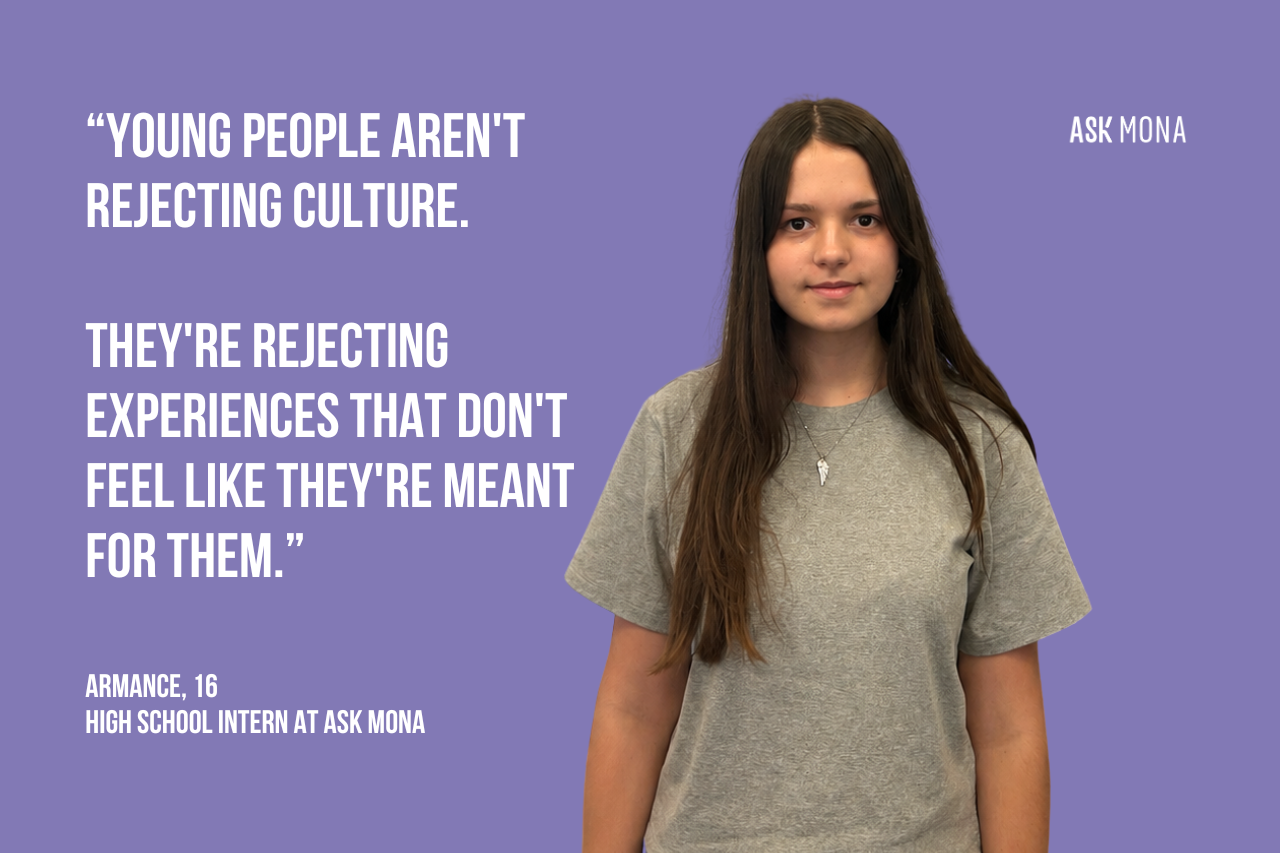
By Armance Melquiot, Year 10 intern at Ask Mona, June 2026
Like many French organizations, Ask Mona welcomed a Year 10 student for a two-week internship. In this article, she shares her generation's perspective on the museum experience.
I'm a high school student. Being a teenager today usually means using AI every single day. To rephrase a sentence, understand a lesson, or explore an idea at two in the morning when nobody else is available. For my generation, AI has become almost instinctive: an always-available conversation partner that never judges and always has an answer, whatever the situation.
What I notice around me, however, is that these same people, curious, connected, and often far more knowledgeable than they think, almost never visit museums or cultural venues unless they're required to by school. It's not simply laziness. It's something more complex.
There is a real gap between young people and cultural institutions. Not a physical one. Museums are there, accessible, and often free for visitors under 26. It's a symbolic gap: the feeling, difficult to put into words but very real, that we are simply not the audience these places were designed for.
Labels written for insiders, the silence that feels almost like a rule you must follow, the lack of an obvious starting point for someone without prior knowledge: all of this creates a quiet form of intimidation. You don't know where to begin. You're afraid of asking a "stupid" question, so you end up asking nothing at all. It's not the art that puts people off. It's the experience surrounding it.
This is where the integration of artificial intelligence into cultural mediation becomes particularly interesting. At Ask Mona, for example, the tools deployed in museums are not designed to "digitize" culture or oversimplify it. They do something much simpler and much more powerful: they make conversation possible.
When visitors can type questions like "Why is this painting in this museum?" or "Who is that person in the background?" without raising their hand, waiting for a guide, or worrying about what other people might think, something changes. The "stupid" question disappears. There is no longer a right or wrong way to approach a work of art. For young people who already interact with AI every day, this format feels immediately familiar. There's nothing new to learn and no friction. The interface looks like something they already use, except now it's helping them discover art.
Several recent projects perfectly illustrate this approach. At the Musée d'Orsay, Ask Mona developed a conversational assistant that helps visitors prepare their visit, find practical information, and navigate the museum without waiting for an email response or making a phone call. At the Palace of Versailles, visitors can even hold real conversations with the sculptures in the gardens.
What these experiences have in common is simple: they adapt to visitors instead of expecting visitors to adapt to them.
It's important to be clear about one thing. A conversational AI does not replace the emotion of a genuine human encounter. It cannot replace the passionate museum educator who brings a gallery to life, nor the silence that settles in front of certain artworks when you suddenly understand what you're looking at. But that has never been its purpose.
Its role is to remove barriers to entry. It helps ensure that a teenager visiting a museum for the first time outside of a school trip doesn't feel like they're entering hostile territory. It provides the keys before the encounter with the artwork truly begins. AI prepares the ground. Humans create the experience. The goal is not to put AI everywhere, but to identify the precise moments where it genuinely adds value.
Young people are not rejecting culture. They are rejecting experiences that feel as though they were designed for someone else. That distance is not inevitable. It's a design challenge.
The promise of this approach is simple: digital tools should not replace cultural experiences. They should make them possible for people who never felt comfortable approaching them in the first place.
My generation already uses AI to learn, to explore, and to ask the questions we don't dare ask elsewhere. It would be a shame not to let us do the very same thing in front of a painting.

What if young people aren't rejecting culture, but the way it's delivered?

.png)

Take the
next step